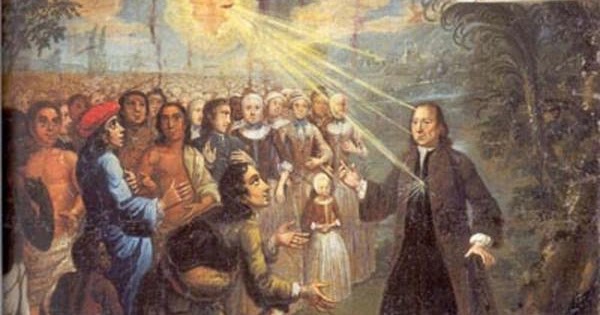
No one present could tell exactly what happened on that Wednesday morning, 13 August 1727 at the specially called Communion service. They hardly knew if they had been on earth or in heaven. Count Nicholas Zinzendorf, the young leader of that community, gave this account many years later:
We needed to come to the Communion with a sense of the loving nearness of the Saviour. This was the great comfort which has made this day a generation ago to be a festival, because on this day twenty-seven years ago the Congregation of Herrnhut, assembled for communion (at the Berthelsdorf church) were all dissatisfied with themselves. They had quit judging each other because they had become convinced, each one, of his lack of worth in the sight of God and each felt himself at this Communion to be view of the noble countenance of the Saviour. O head so full of bruises, So full of pain and scorn. In this view of the man of sorrows and acquainted with grief, their hearts told them that He would be their patron and their priest who was at once changing their tears into oil of gladness and their misery into happiness. This firm confidence changed them in a single moment into happy people which they are to this day, and into their happiness they have since led may thousands of others through the memory and help which the heavenly grace once given to themselves, so many thousand times confirmed to them since then .
Zinzendorf described it as ‘a sense of the nearness of Christ’ given to everyone present, and also to others of their community who were working elsewhere at the time.
The congregation was young. Zinzendorf, the human leader, was 27, which was about the average age of the group.
The Moravian brethren had sprung from the labors and martyrdom of the Bohemian Reformer, John Huss. They had experienced centuries of persecution. Many had been killed, imprisoned, tortured or banished from their homeland. This group had fled for refuge to Germany where the young Christian nobleman, Count Zinzendorf, offered them asylum on his estates in Saxony. They named their new home Herrnhut, ‘the Lord’s Watch’. From there, after their baptism in the Holy Spirit, they became evangelists and missionaries.
Fifty years before the beginning of modern Foreign Missions by William Carey, the Moravian Church had sent out over 100 missionaries. Their English missionary magazine, Periodical Accounts, inspired William Carey. He threw a copy of the paper on a table at a Baptist meeting, saying, ‘See what the Moravians have done! Cannot we follow their example and in obedience to our Heavenly Master go out into the world, and preach the Gospel to the heathen?’
That missionary zeal began with the outpouring of the Holy Spirit. Count Zinzendorf observed ‘ The Saviour permitted to come upon us a Spirit of whom we had hitherto not had any experience or knowledge. … Hitherto we had been the leaders and helpers. Now the Holy Spirit Himself took full control of everything and everybody’.


